Architecture
mattebox@0.13.0
Mattebox is a kernel plus stages. This document lists every layer and module and how they fit together. For usage, read the guide.
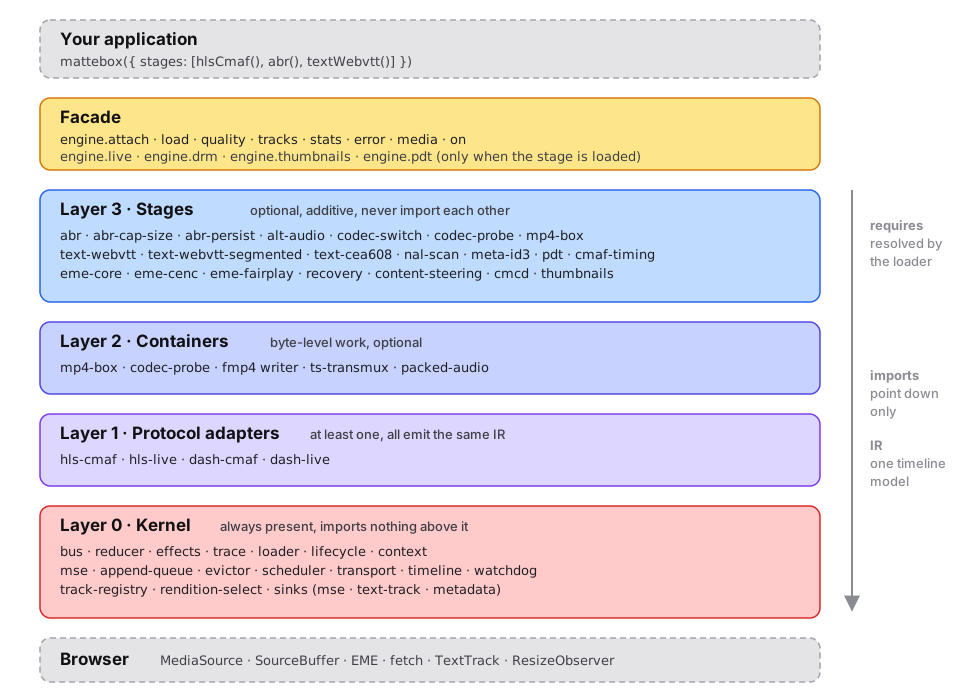
Layers
| Layer | Role | Optional | Imports |
|---|---|---|---|
| 0 | Kernel: message loop, MSE, scheduling, transport | No | Nothing above it |
| 1 | Protocol adapters: manifest text to the IR | At least one | Kernel |
| 2 | Containers: byte-level work on segments | Yes | Kernel |
| 3 | Stages: every feature | Yes | Kernel, and layer 2 through requires |
Three rules:
- Imports point down. The kernel imports nothing from above. Stages never import each other.
- Protocol adapters emit one intermediate representation (IR). Nothing above layer 1 branches on protocol.
- The reducer is pure. Effects are plain data that a runner executes outside the loop.
Layer 0: the kernel
The kernel alone is a working player: it attaches and plays the lowest rendition once a protocol adapter parses a manifest.
| Module | Responsibility |
|---|---|
bus |
One queue for every message. Registries for sinks, parsers, transforms, and namespaces |
reducer |
Pure reduce(state, message) returning the next state and a list of effects |
effects |
Runs effect descriptors through registered handlers. Results re-enter as facts |
trace |
The diagnostic ring buffer, its export format, and offline replay |
loader |
Resolves requires into an install order. Duplicate and missing capabilities fail here |
lifecycle |
Attach and detach sequences, element listeners, stage teardown in reverse order |
context |
The StageContext every stage receives at install |
mime |
MIME type normalization, shared by the engine, the reducer, and the adapters |
mse |
MediaSource and ManagedMediaSource lifecycle, SourceBuffer creation, changeType |
append-queue |
Per-SourceBuffer FIFO serialized on updateend, quota retry |
evictor |
Back-buffer removal under quota pressure |
scheduler |
The buffer-goal loop. Decides what to fetch next per track. Knows nothing about SourceBuffers |
transport |
Fetch wrapper with byte ranges, abort, retry, and request and response hooks |
prepare |
Runs the transform pipeline and the time probe on media bytes between the transport and the reducer |
timeline |
Media time to presentation time. Discontinuities and period boundaries are handled the same way |
watchdog |
Detects a decoder that stopped inside buffered data and reports a stall |
track-registry |
Track enumeration and selection, the engine.tracks surface |
rendition-select |
The constraint solver behind engine.quality. Pins and named constraints |
sinks/mse-sink |
Audio and video bytes to SourceBuffers |
sinks/text-track-sink |
Text cues to a native TextTrack |
sinks/metadata-sink |
Timed metadata cues to a metadata TextTrack |
The message loop
Five things write player state: the app, ABR, network responses, MSE callbacks, and manifest refreshes. The bus puts them in one queue.
| Kind | Direction | Can be rejected | Examples |
|---|---|---|---|
| Command | In, from app or stage | Yes | LOAD, SEEK, PIN_RENDITION, SELECT_TRACK |
| Fact | In, from the browser or network | No | SEGMENT_LOADED, SOURCEBUFFER_UPDATEEND |
| Effect | Out, to the runner | Not applicable | fetch, append, remove, schedule, emit |
Every message and its effects go into the trace. Replaying a trace into a fresh reducer must produce the same effects. See Diagnostics.
The IR
Every protocol adapter produces this model. Everything above layer 1 reads it.
| Type | Holds |
|---|---|
Presentation |
isLive, duration, periods, couplings, live metadata, steering |
Period |
Start, duration, tracks |
Track |
Content type, MIME type, language, role, protection, renditions |
Rendition |
Bitrate, resolution, frame rate, codecs, init segment, segment list |
Segment |
Sequence number, start, duration, URL, byte range, discontinuity flag |
Coupling |
Which audio and text tracks an HLS video rendition requires |
Tracks carry a protection field even when no DRM stage is loaded, so DRM
can stay optional.
Sinks
Text and metadata are pipelines like audio and video. Each content type has a sink.
| Sink | Destination | Content types |
|---|---|---|
MseSink |
SourceBuffer.appendBuffer |
video, audio |
TextTrackSink |
TextTrack.addCue |
text |
MetadataSink |
Cues on a metadata TextTrack |
metadata |
A track whose content type has no registered sink is listed but not selectable.
Layer 1: protocol adapters
| Module | Directory | Responsibility | Requires |
|---|---|---|---|
hls-cmaf |
src/protocols/hls-cmaf |
Multivariant and media playlists, byte ranges, keys, couplings | kernel |
hls-live |
src/protocols/hls-live |
Playlist reload on the target-duration cadence, sliding window, ENDLIST |
hls-cmaf |
dash-cmaf |
src/protocols/dash-cmaf |
MPD parsing, SegmentTemplate, SegmentTimeline, SegmentBase with sidx |
kernel |
dash-live |
src/protocols/dash-live |
Live window from availabilityStartTime, UTCTiming, MPD refresh |
dash-cmaf |
Both live adapters register engine.live.
Layer 2: containers
| Module | Directory | Responsibility |
|---|---|---|
mp4-box |
src/containers/mp4-box |
A minimal ISOBMFF walker. Finds boxes, reads tfdt and sidx |
codec-probe |
src/containers/codec-probe |
Derives the exact codec string from an init segment |
fmp4 |
src/containers/fmp4 |
Writes init and media segments. Shared by the transmuxer and packed audio |
ts-transmux |
src/containers/ts-transmux |
MPEG-TS demux to fMP4 in a Worker. Extracts CEA-608 bytes on request |
packed-audio |
src/containers/packed-audio |
Raw AAC segments, with or without an ID3 header, wrapped as fMP4 |
ts-transmux, packed-audio, and the aes-128 stage register a transform
step and provide media-transform, which routes every append through the
transform pipeline.
Layer 3: stages
Stages group by feature. Each row is one directory under src/stages/.
Quality
| Stage | Responsibility | Requires | Namespace |
|---|---|---|---|
abr |
Picks renditions from throughput and buffer level. Registers the chooser and an emergency floor | scheduler, track-registry |
|
abr-cap-size |
Caps rendition height to the element size | rendition-select |
|
codec-switch |
Answers whether a rendition switch is seamless, needs changeType, or a reload |
mse |
|
codec-probe |
Publishes the codec string derived from init segments | mp4-box |
codecProbe |
mp4-box |
Exposes the box walker as engine.mp4box |
mp4box |
Audio, text, and metadata
| Stage | Responsibility | Requires |
|---|---|---|
alt-audio |
Keeps the audio track consistent with the video rendition’s audio group | scheduler, codec-switch |
text-webvtt |
WebVTT parser and the text sink | scheduler |
text-webvtt-segmented |
Applies X-TIMESTAMP-MAP offsets to segmented HLS subtitles |
text-webvtt |
text-cea608 |
CEA-608 captions from SEI to a native caption track | nal-scan or ts-transmux |
nal-scan |
Finds SEI units in H.264 and HEVC fMP4 samples for CEA-608 | |
meta-id3 |
ID3 timed metadata to a metadata track | media-transform |
Live
| Stage | Responsibility | Requires | Namespace |
|---|---|---|---|
pdt |
Converts between wall clock and presentation time | timeline |
pdt |
cmaf-timing |
Reads each segment’s decode time so the kernel lands it at its manifest time |
Legacy HLS
| Stage | Responsibility |
|---|---|
aes-128 |
Decrypts METHOD=AES-128 segments before the transmuxer |
DRM
| Stage | Responsibility | Requires | Namespace |
|---|---|---|---|
eme-core |
The EME handshake, session management, ClearKey | mse |
drm |
eme-cenc |
Widevine and PlayReady license request and response shapes | eme-core |
|
eme-fairplay |
FairPlay’s SPC and CKC flow, certificate fetch | eme-core |
Recovery, CDN, and thumbnails
| Stage | Responsibility | Requires | Namespace |
|---|---|---|---|
recovery |
Rendition exclusion, gap jumps, flushes, segment skips on failure | scheduler, mse |
|
content-steering |
Pathway priority from a steering manifest, failover | transport |
|
cmcd |
Common Media Client Data on every request | transport |
|
thumbnails |
Sprite-sheet tiles from a WebVTT thumbnail track | transport |
thumbnails |
Dependency rules
dependency-cruiser enforces the layering. The rules are in
.dependency-cruiser.cjs.
| Rule | Forbids |
|---|---|
kernel-is-sovereign |
Kernel importing protocols, containers, or stages |
no-lateral-stage-imports |
A stage importing another stage |
protocols-emit-ir-only |
A protocol adapter importing a stage |
no-lateral-protocol-imports |
HLS adapters importing DASH adapters, and the reverse |
containers-are-leaf-ish |
A container importing a protocol or a stage |
no-circular |
Any import cycle |
zero-runtime-deps |
Any import from node_modules inside src/ |
no-orphans |
A module nothing imports |
Type-only imports count too. A stage that needs another module declares it
in requires, and the loader checks that at startup.
How a stage plugs in
A stage is a factory that returns a name, what it provides, what it requires,
and an install function. Nothing happens at import time.
export default function myStage(): Stage {
  return {
    name: 'my-stage',
    provides: ['my-stage'],
    requires: ['scheduler'],
    install(ctx) {
      const off = ctx.on('tracks:changed', () => {});
      return () => off();
    },
  };
}
install receives a StageContext. Everything a stage does goes through it.
| Hook | Registers | Used by |
|---|---|---|
registerSink |
A destination for a content type | text-webvtt, meta-id3 |
registerParser |
Bytes to cues for one MIME type | text-webvtt, meta-id3 |
registerTransform |
One ordered step in the segment byte pipeline | ts-transmux, aes-128 |
registerTimeProbe |
The reader of a media segment’s start decode time, one per composition | cmaf-timing |
registerNamespace |
A public API at engine.<name> |
eme-core, thumbnails, pdt |
registerChooser |
The rendition chooser | abr |
registerSwitchPolicy |
Whether a rendition switch is seamless, needs changeType, or a reload |
codec-switch |
reduce |
A named state slice with its own pure reducer; sees facts and accepted commands | protocol adapters, recovery |
addRequestHook |
Sees and rewrites outgoing requests | cmcd, content-steering |
request |
A one-off fetch through the transport | eme-core, thumbnails |
dispatch, on, emit |
Commands in, events out | every stage |
The lifecycle:
mattebox()resolvesrequiresand orders the stages.attach()installs each stage against the element, in that order.detach()runs every teardown in reverse order and clears the element.
Transforms run in ascending order: decryption first, the transmuxer at
100, caption extraction and timing fixes at 150.
See also
- Guide for usage.
- Presets and stages for building your own stack.
- Diagnostics for the trace and replay.